How Binauro's Free Ambient Soundscapes Work
Spatial recording techniques, 20-band EQ presets, hearing-safe filters, Opus encoding, and a commitment to free audio.
There is no shortage of ambient sound libraries on the internet. Search for "rain sounds for sleep" and you will find thousands of results: YouTube uploads, apps, streaming playlists. Most of them share the same approach: loop a recording, press play, done.
Binauro takes a different approach. Every soundscape in the library has been selected or recorded specifically for spatial character, processed with hearing-safe techniques, encoded with a modern codec, and given a set of hand-crafted EQ presets that let you reshape the sound entirely. This article explains exactly how and why, from microphone placement to the file that ends up in your browser.
The goal is not just to give you background noise. It is to give you a living acoustic environment you can inhabit, shape, and trust to be safe for long listening sessions.
Binaural & Spatial Recording
Standard stereo places sound on a flat left-to-right plane. Binaural recording goes further: two microphones are placed at roughly the distance between human ears, often mounted inside a dummy head or on a custom rig, and the result, when played through headphones, produces a convincing three-dimensional sound field. You do not just hear the rain to your left and right. You hear it above, behind, and in front of you.
Real locations, real capture
Binauro's binaural recordings come from specific, carefully chosen locations. Alpine Creek was recorded in the northern French Alps, the two-microphone setup capturing the unique acoustic signature of glacial water rushing over smooth alpine rock. Be a Tree places you inside a forest in Slovenia, microphones mounted on a tree trunk at ear height to capture simultaneous rain and a nearby creek with natural distance separation. These are not studio simulations but real environments captured with spatial microphones.
The Spatial Mixer: build your own 3D environment
For sounds that are not binaural recordings, Binauro's Spatial Audio Mixer lets you position any sound in a virtual 3D space around your head. You can place rain overhead, a creek to your left, and distant city sounds behind you. The mixer uses Head-Related Transfer Function (HRTF) processing to simulate how the human ear perceives spatial audio, a technique used in professional game audio and VR production.
EQ Presets: Shaping Every Sound
Every soundscape in Binauro's library comes with multiple hand-crafted EQ presets. The presets are not generic "bass boost" or "treble cut" adjustments but are carefully tuned frequency profiles designed to change the character of a recording, so you can choose your individual listening experiences.
Up to 20 frequency bands, per preset
The most detailed presets operate across a full 20-band equalizer spanning from sub-bass to air frequencies. Take Japanese Creek Bamboo. Its five presets include:
| Preset | Character | What it does |
|---|---|---|
| Cleaned | Pure garden | Deep high-pass at −24 dB removes all sub-bass rumble — only water and bamboo remain |
| The Clack | Percussive | Isolates the sharp wood-on-stone strike of the fountain, boosting 400 Hz–1 kHz |
| Paper Screen | Muffled warmth | Simulates hearing the garden through a sliding shoji door — aggressive high-frequency roll-off above 1 kHz |
| Koi Pond | Bright surface | Removes all bass, emphasizes the thin, glassy splashes at the water surface |
| Moss Stone | Deep meditation | Controlled warmth with no air — complete roll-off above 1.6 kHz for a sealed, earthy feel |
Five completely different listening experiences, all from the same original recording file. This approach means Binauro can serve vastly different use cases (deep focus, light background, sleep, meditation) without multiplying the number of source files and bandwidth costs.
You can see these presets as interpretations. A single recording of ocean waves, sculpted correctly, can become a sleep companion at 3 AM or a concentration anchor during a difficult work session.
High-Pass & Low-Pass Filters: Cleaner & Safer Audio
Field recordings pick up far more than the human ear notices in the moment. A microphone near a river will capture the water beautifully, and also sub-bass wind rumble, distant traffic vibration, handling noise, and low-frequency hum from whatever surface the recorder is resting on. At the playback stage, these inaudible-in-the-field artefacts can cause real problems.
High-pass filtering: removing the rumble
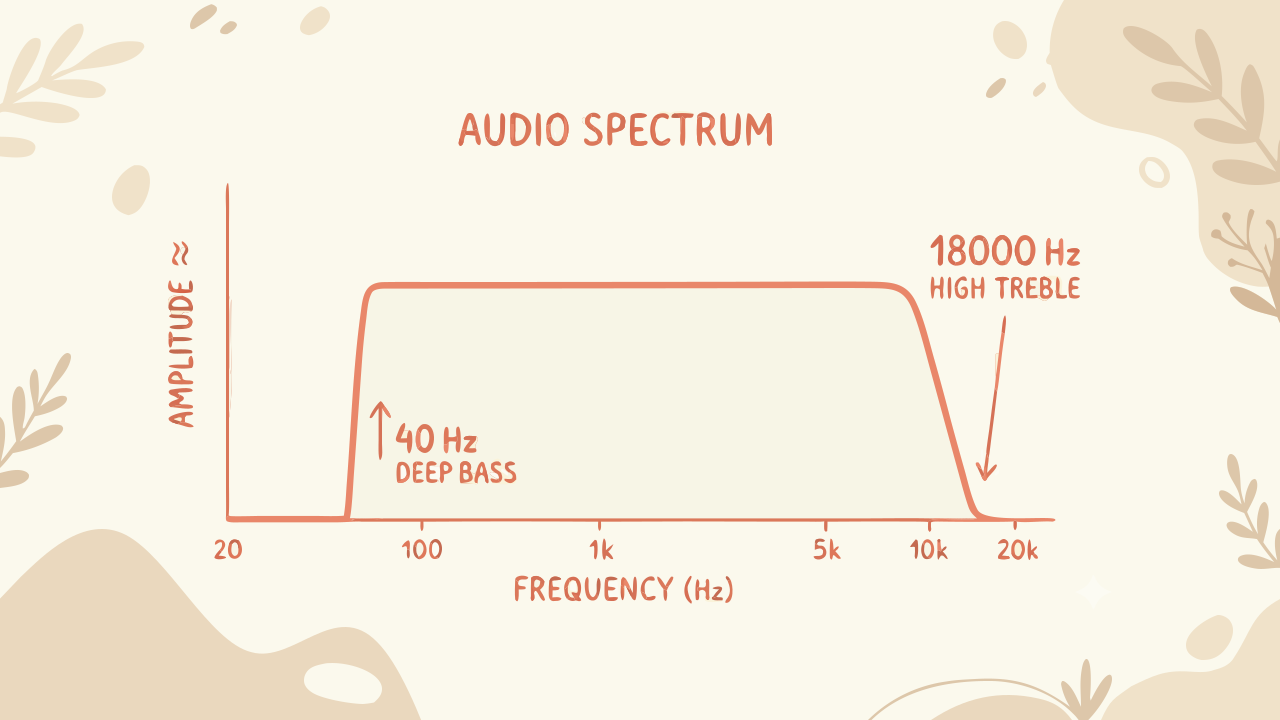
A high-pass filter (sometimes called a low-cut) allows frequencies above a certain threshold to pass through while attenuating everything below. Applied to a field recording, it removes sub-bass content, typically below 80–120 Hz, that carries no musical information for ambient purposes but adds unnecessary energy that your headphone drivers and amplifier must reproduce.
The practical benefit is twofold. First, the recording sounds cleaner and more focused. The brain stops processing the low-level infrasonic material it was unconsciously tracking. Second, removing this content is protective: prolonged exposure to very low frequencies at listening volume has been linked to ear fatigue and, in extreme cases, inner-ear stress. Removing it costs nothing audible and is simply good practice.
Low-pass filtering: protecting the high end
A low-pass filter does the opposite: it silences frequencies above a threshold while leaving the lower spectrum intact. For ambient recordings, this is used primarily for safety rather than cleaning: very high frequencies (above 16 kHz) can contain recording artefacts, microphone self-noise, or harsh digital ringing that, over long listening sessions, causes listener fatigue and ear strain.
The "Cozy" and "Muffled" preset families across Binauro's library apply a carefully shaped low-pass shelf that rolls off smoothly above 3–6 kHz, preserving the warmth and body of a sound while removing the fatiguing energy. The result is audio that you can safely listen to for two or three hours without the creeping ear pressure that poorly mastered ambient tracks cause.
Sub-bass rumble removed below 80 Hz on field recordings where it carries no musical content.
High-frequency artefacts and self-noise attenuated or removed above 14–16 kHz where applicable.
All filtering is applied during production. The .opus file you receive is already clean and hearing-safe.
Preset EQs are gain-limited: no preset applies more than +14 dB of boost at any band, preventing driver overload.
Opus Encoding: Why the Codec Matters
Every audio file in Binauro's library is served as .opus, a modern open-source codec developed by the Xiph.Org Foundation and standardized by the IETF (RFC 6716). The choice of Opus over MP3, AAC, or OGG Vorbis is not clear: it has measurable implications for sound quality, file size, and streaming performance.
Better quality at the same file size
Blind listening tests consistently show that Opus at 196 kbps is perceptually equivalent to lossless FLAC. For ambient sounds, which contain broadband noise, complex textures, and sustained tones, this difference is especially audible. Other compressions like MP3 introduces pre-ringing artefacts that are masked in transient-heavy music but become clearly audible in steady ambient textures like rain or ocean waves. Opus handles these textures cleanly.
| Codec | Bitrate for "transparent" quality | Open source | Browser support |
|---|---|---|---|
| MP3 | ~192 kbps | No (patent-free since 2017) | Universal |
| AAC | ~128 kbps | No | Most browsers |
| OGG Vorbis | ~112 kbps | Yes | Modern browsers |
| Opus | ~196 kbps | Yes (IETF standard) | All modern browsers |
Smaller files mean faster playback and lower bandwidth
Because Binauro is free and self-funded, bandwidth is a real cost. Serving a 5-minute ambient loop at Opus 196 kbps uses roughly 3.5 MB. The same loop at MP3 uses nearly 7 MB. Across many thousands of daily plays, the difference is significant and the savings go directly into keeping the library free and expanding it with new recordings. Opus lets Binauro serve better quality for half the bandwidth cost of MP3.
The encoding pipeline
Raw field recordings arrive as WAV or high-quality FLAC. They go through a cleaning stage: removing DC offset, trimming silence, applying the high-pass filter, before being loop-point trimmed to ensure seamless repetition. The final step is encoding with libopus at a bitrate chosen per sound type: binaural recordings with wide stereo field at 128 kbps, mono or narrow stereo backgrounds at 80–96 kbps. The master WAV is archived so future re-encoding at higher bitrates is always possible.
Where the Sounds Come From
Binauro's library draws from two sources: the Freesound community and original field recordings made by Binauro. Both are treated with equal care in production, but they have different stories.
Freesound: the world's largest collaborative sound archive
Freesound is a Creative Commons audio repository run by the Music Technology Group at Universitat Pompeu Fabra in Barcelona. It contains over 600,000 sounds contributed by recordists around the world, released under various Creative Commons licenses. Binauro treats Freesound not as a bulk content source but as a curated archive to search carefully. Every track selected for Binauro's library goes through a multi-stage evaluation: spatial character, recording quality, loop potential, low-end cleanliness, and license type.
Only a small fraction of sounds reviewed actually make the library. The selection process favours recordings with interesting spatial depth. Those made with binaural setups or in acoustically distinctive spaces and discards and those with excessive background noise, heavy compression, or poor dynamic range.
Binauro original recordings
Several sounds in the library are self-recorded by Binauro, identifiable by the "Binauro — Original Recording" credit in the player. These include:
Pancake Rain
Recorded in a my kitchen while making pancakes during an unexpected rain shower: the combination of window rain and warm kitchen acoustics creates a uniquely cozy indoor atmosphere.
Japanese Creek Bamboo
A Shishi-odoshi (bamboo water fountain) in a private garden, recorded with two microphones positioned to capture both the clack of bamboo and the surrounding creek.
Underwater Bubbles
Deep, rhythmic bubbling recorded close to a straw bubbling air into a cup of water.
and many more ...
Author Credits: Every Sound Has a Name
Every sound in the Binauro library carries a visible, clickable credit in the player. This is non-negotiable. When a sound was sourced from Freesound, the recordist's username and a direct link to their original upload are displayed. As part of the standard player interface.
The current library credits a growing roster of recordists from around the world. Some examples: kevp888 (Alpine Creek in the French Alps, Waves at Night), EllipsenPark (Be a Tree in Slovenia), RdmnPrd (Kayak on calm water), and eguaus (Roof Rain). Each of these people invested time, equipment, and creative effort to capture something real. The least Binauro can do is make sure their names are visible every time their work is played.
If you discover your recording used incorrectly, with a missing credit, or under the wrong license, contact Binauro immediately. The library will be corrected and, if removal is requested, the track will be taken down promptly.
For Binauro's own original recordings, the credit reads "Binauro — Original Recording".
Free & Open: Supporting the Web That Gave Us This
Binauro exists because of the open web. The Freesound community built its archive on Creative Commons. The Opus codec was developed as an open standard by a nonprofit. The Web Audio API that powers Binauro's player is a W3C open standard. Every foundational technology Binauro depends on was created by people who chose to share.
In that spirit, Binauro's core tools: the soundscapes library, the binaural beats generator, the spatial mixer, the isochronic tones, are and will remain free. No paywall, account, ads that track you. The library runs on voluntary donations and self-funding, and it explicitly avoids the subscription model that has turned most audio tools into monthly obligations.
No tracking ads. Binauro uses Simple Analytics, a privacy-first tool that does not fingerprint or track users across sites.
No required sign-up. Every tool on the site works without an account.
Open credits. Every sourced recording credits its author with a link to the original.
Bandwidth-efficient. Opus encoding keeps costs low, which keeps the service free.
No paywalled sounds. Every sound in the library is accessible to every visitor.
If you want to help keep the library growing and the hosting bills paid, the best things you can do are: share Binauro with someone who needs it, leave a review if you use the Android app, or make a small one-time donation.
Explore the Soundscape Library
Free ambient soundscapes for sleep, focus, and relaxation. Rain, ocean, forest, creek, fire, and more — each with spatial EQ presets, no account required.
Open the Soundscapes LibraryFrequently Asked Questions
All of them are. Recordings like Alpine Creek (French Alps) and Be a Tree (Slovenia) were captured with two microphones placed at ear distance, producing genuine binaural stereo that creates a 3D spatial effect when heard through headphones.
The Spatial Mixer lets you take any ambient sound and position it in a virtual 3D space around your head: left, right, front, back, or overhead. You can combine multiple sounds with different positions to build a fully custom acoustic environment.
Opus is a modern open-source codec standardized by the IETF. At the same bitrate, Opus delivers noticeably better audio quality than MP3, especially for ambient textures and broadband noise. It also streams faster and uses less bandwidth, making it ideal for a free browser-based app.
Each preset is a hand-crafted set of EQ adjustments across up to 20 frequency bands. For example, a 'Cozy' preset might boost the low frequencies and cut the high-end to simulate hearing rain from inside a warm room, while a 'Crisp' preset does the opposite. The gain values are designed to be musically useful, not just technically correct.
A high-pass filter removes very low frequencies (sub-bass rumble) from a recording. Microphones can pick up handling noise, wind turbulence, HVAC hum, and footstep vibrations that are inaudible in the field but fatiguing or even harmful at listening volume. Applying a high-pass during production removes this before the file ever reaches your ears.
Each sound has its own license that depends on the original source. Sounds marked 'Binauro Original Recording' are self-produced. Freesound-sourced sounds carry their creator's chosen Creative Commons license. Check the credit displayed in the player for each track — the source URL links directly to the license page.
Choose a steady, low-dynamics sound like Deep Tide (ocean waves) or Insulated Attic (roof rain). Keep the volume just above your room's ambient noise level, loud enough to mask sudden sounds, soft enough not to disrupt sleep cycles. Use a browser sleep timer to fade out after 30–60 minutes.
Speakers work well for general masking and relaxation. Headphones unlock the full binaural effect on recordings captured with two microphones, and they make the Spatial Mixer far more effective, the 3D positioning is dramatically more convincing through headphones than speakers.
Attribution & Licensing
Freesound-sourced recordings are used under their respective Creative Commons licenses. Authors are credited in the player with a direct link to the original upload. Binauro original recordings are self-produced. For licensing enquiries, contact us via the site footer.Binauro does not use cookies or third-party tracking. Your settings stay on your device.